Scope of Fashion designing on domestic level.
Fashion designing is the science of geometry, color and drapery all rolled into one. It is associated with creating designs for menswear, women wear, teen fashion wear and extends to accessories like jewelry, and footwear also. Fashion designing is an intellectually satisfying and lucrative profession today. As the domestic demand for ready to wear increase, the fashion industry today pivots on the evolving dynamism and energy of the international design world. Creative and innovative Fashion Designers rise to become Global Brand Icons, Media Personalities, Industry Stalwarts or ultimately, Celebrated Images symbolizing the remarkable look, feel and attributes to the era. The fashion industry is a product of the modern age. Prior to the mid-19th century, virtually all clothing was handmade for individuals, either as home production or on order from dressmakers and tailors. By the beginning of the 20th century,with the rise of new technologies such as the sewing machine, the rise of global capitalism and the development of the factory system of production, and the proliferation of retail outlets such as department stores, clothing had increasingly come to be massproduced in standard sizes and sold at fixed prices. Although the fashion industry developed first in Europe and America, today it is an international and highly globalized industry, with clothing often designed in one country, manufactured in another, and sold in a third.

• Fashion Designing as a field of study:
Fashion Designing is one of the upcoming career options in today’s world and it is becoming famous day by day among the people with creative minds. It is glamorous, appealing, and exciting career option. With this degree students have number of choices in front of them. The fashion designers have varied options including designing, research, cloth production, textile designing, etc.
• Who Is a Fashion Designer?
A fashion designer is a person who studies fashion trends, sketches designs, picks fabrics and oversees the general production of clothing and accessories. Most people often mistaken tailoring/dress making to fashion designing, although they work hand in hand, there is a significant difference between them.
• Skills Required to Become a Fashion Designer
Creative Skills
Good eye for materials
Business skills O
Strong visualization skills
Information about current fashion trends
Drawing and sketching skills
Soft skills
• Product promoters:
There are many other options as well for instance you can also work with Film production units as TV/Film fashion program producers/costume designers etc. Invite guest speaker from garment industry to address the students to highlight scope and importance of Fashion.
What Is Pret-A-Porter Exactly.
Pret-a-Porter fashion, also known as ready – to-wear fashion, describes the ready -made, ie not tailor -made, fashion collections of designers and labels. Ready -made fashion is one that we find in retail in various, fixed. sizes on the shelves. the designer’s Pret-a-Porter collections are admired and celebrated. For the designers themselves, the Pret-a-Porter collections are extremely important in addition to haute couture, because the ready-to-wear fashion boosts the marketing of designers enormously.
3.2Haute Couture:
Haute couture is defined as the high end or luxurious fashion that majorly fulfills the demands of “high society” of fashion collections by designers. The term comes from France, Haute means high end and couture means fashionand refers to the upscale designs of fashion designers from the top tier. The French fashion association sets rules and specifications so that the ranks of Couturiers remain exclusive.

4. Evolution of Fashion
4.1 Know the evolution of Fashion (mid 80’s – till date)
Fashion is a universal subject, a language understood and spoken by many. When we look back over the last 100 years, the change and influence fashion has seen has been exponential. Decade after decade, new trends have been introduced, themselves heavily influenced by pop culture, political attitudes and inspiring style icons of the time. It is a mode of expression for so many and considered a necessity by others. To be ‘fashionable’ was very much associated with wealth in bygone years but as we entered into the glittering Great Gatsby era of the 1920s, fashion became liberated as Coco  Chanel took to the throne (in a fashion sense, of course.) She popularized so many pivotal fashion trends that we still wear today including the little black dress, espadrilles and costume jeweler but she was also a driving force behind this liberation movement, an advocate for casual dressing as corsets were removed and trousers for women became the new wardrobe staple. By the 1950s, the French designer, Christian Dior, had introduced us to one of fashion’s most widely-worn trends – the pencil skirt. A popular choice for the First Lady of the time, Jackie Kennedy.In what became known as the ‘rebellious era’, the 1960s was a great contrast to previous decades.
  It was a time of great upheaval, both politically and creatively and is synonymous with a much shorter hemline as governed by British designer, Mary Quant presented and her mini skirt. Mod fashion also came into play, with bold geometric shapes, bright primary colours and psychedelic prints introduced by designer, Emilio Pucci. It was the decade of experimentation and non-conformity, which carried on through to the 1970s. As hemlines began to get longer and trousers grew tighter, bohemian dressing took center stage – literally, in the case of style icon, Joni Mitchell. Long, flowing skirts, the DVF wrap dress and embroidered, peasant style clothing became increasingly popular, advocated by stores including Biba and Laura Ashley. The 1970s is a perfect example of the cyclicality in fashion trends. Last summer, more than 40 years on, we have seen the off-shoulder Bardot and embroidery trends taking over our favorite high street stores once more in a revival of the most popular looks from the decade. Today, the fashion industry is a highly reputable, competitive and wonderfully influential business. Our searing dedication and interest in the biannual shows at fashion week or excitement following the arrival of new season stock in Topshop has not wavered. Our commitment to fashion and looking stylish still remains original and passionate, more than 100 years on.
 Chanel took to the throne (in a fashion sense, of course.) She popularized so many pivotal fashion trends that we still wear today including the little black dress, espadrilles and costume jeweler but she was also a driving force behind this liberation movement, an advocate for casual dressing as corsets were removed and trousers for women became the new wardrobe staple. By the 1950s, the French designer, Christian Dior, had introduced us to one of fashion’s most widely-worn trends – the pencil skirt. A popular choice for the First Lady of the time, Jackie Kennedy.In what became known as the ‘rebellious era’, the 1960s was a great contrast to previous decades.
 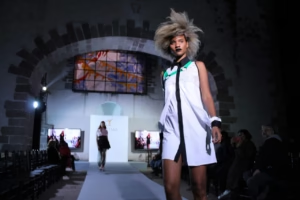 It was a time of great upheaval, both politically and creatively and is synonymous with a much shorter hemline as governed by British designer, Mary Quant presented and her mini skirt. Mod fashion also came into play, with bold geometric shapes, bright primary colours and psychedelic prints introduced by designer, Emilio Pucci. It was the decade of experimentation and non-conformity, which carried on through to the 1970s. As hemlines began to get longer and trousers grew tighter, bohemian dressing took center stage – literally, in the case of style icon, Joni Mitchell. Long, flowing skirts, the DVF wrap dress and embroidered, peasant style clothing became increasingly popular, advocated by stores including Biba and Laura Ashley. The 1970s is a perfect example of the cyclicality in fashion trends. Last summer, more than 40 years on, we have seen the off-shoulder Bardot and embroidery trends taking over our favorite high street stores once more in a revival of the most popular looks from the decade. Today, the fashion industry is a highly reputable, competitive and wonderfully influential business. Our searing dedication and interest in the biannual shows at fashion week or excitement following the arrival of new season stock in Topshop has not wavered. Our commitment to fashion and looking stylish still remains original and passionate, more than 100 years on.
 Activity: Visit any cultural museum to observe the evolution of Fashion Designing