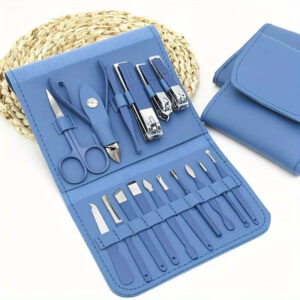
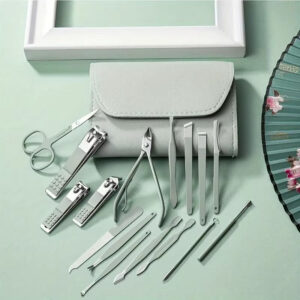
16pcs Professional Nail Clippers and Cuticle Nippers Set.

This isn’t just a few clippers thrown together. This set is divided into three main categories: facial care, hand care, and foot care.

  1. The Heavy Hitters: Nail & Toenail Clippers

The kit features three different sizes of clippers. Why three? Because using the same small clipper for your tough thumbnails and delicate fingernails is a recipe for a bad trim.

  • Large Clipper: Built with more leverage for those thicker toenails.
  • Medium Clipper: Your everyday go-to for fingernails.
  • Diagonal Clipper: This is the unsung hero. It’s angled specifically to get into the corners of your nails to prevent ingrown or to snip off a hangnail without tearing the skin.
  1. Precision Tools: Cuticle Nippers & Scissors

If you’ve ever tried to trim a cuticle with a regular clipper, you know the pain of “the nick.” The professional-grade cuticle nipper in this set allows for a high degree of precision. It’s spring-loaded, which means you have total control. Pair that with the fine-tipped grooming scissors perfect for trimming unruly eyebrows or nose hairs and you’ve got a full salon setup in the palm of your hand.

  1. Facial & Detail Tools

This is where the kit goes above and beyond. You’ll find:

  • Tweezers: Sturdy, slanted tips that actually grip the hair instead of just sliding off it.
  • Ear Picks: Two different styles for gentle cleaning.
  • Acne Needles/Loop Extractors: For those who know how to handle a blemish properly without causing scarring.
  1. Smoothing & Finishing

A nail isn’t finished until it’s smooth. The kit includes a high-grit metal file that doesn’t wear down like those disposable emery boards. There are also various “pushers” and “shovels” used to clean under the nail bed and push back cuticles, giving you that clean, elongated nail look.

  1. The Face Savers It’s not just about nails. This kit handles the “above the neck” stuff too: Tweezers that actually work: We’ve all used those cheap tweezers that just slide off the hair. These have a solid grip.

The Beauty Scissors: Perfect for trimming a mustache or those wild eyebrow hairs.

Ear Picks: It comes with two styles (scoop and spiral) for a much safer way to clean your ears than jamming a Q-tip in there.

The Big Guy: This is for those stubborn toenails that regular clippers just bend against. It’s got the leverage to get the job done without you breaking a sweat.

The Standard Clipper: Your everyday tool for fingernails.

The Angled/Diagonal Clipper: This is the secret weapon. If you’ve ever had an ingrown nail or a painful hangnail, this angled edge lets you snip it right at the source without tearing your skin.

Why Quality Matters (And Why Your Skin Will Thank You)

A lot of cheap kits use low-grade metals that rust after two months or, worse, get dull. A dull blade doesn’t “cut” your nail; it crushes it. This leads to splitting, peeling, and jagged edges.

The tools in this set are crafted from stainless steel with a matte finish. This provides a better grip (no more clippers flying out of your hand across the bathroom) and ensures the blades stay sharp for years. Plus, the matte coating is much easier to sanitize—a quick wipe with some rubbing alcohol and you’re good to go.

The “Human” Benefit: Why You Need This

Beyond the technical specs, there’s a psychological benefit to owning a kit like this. There is a specific kind of “adulting” satisfaction that comes from having a dedicated place for your tools.

Instead of frantic searching, you have a ritual. Sunday night rolls around, you grab your kit, and you take ten minutes to reset. It’s self-care that isn’t fluffy or over-the-top—it’s just practical maintenance that makes you feel more confident on Monday morning.

The Perfect Gift?

The Clippers: There are three different ones. A big one for those tough toenails, a medium one for your fingers, and an angled one. That angled one is a life-saver for getting into the corners of your nails without hurting yourself.

The Face Stuff: It’s got a solid pair of tweezers (that actually grip the hair!), tiny scissors for trimming eyebrows or a mustache, and even some ear picks.

The Extras: It also has tools for clearing out blackheads or pushing back your cuticles. If you’ve ever wanted your hands to look like you just came from a professional salon, these are the tools you need.

Final Thoughts

At the end of the day, grooming is about more than just looking good; it’s about hygiene and health. Properly trimmed nails and clean skin prevent infections and keep you feeling sharp. This 16-piece set takes the guesswork out of it.

It’s sleek, it’s sharp (literally), and it’s organized. Stop settling for dull, mismatched tools and give your grooming routine the upgrade it deserves. Your hands and your sanity will thank you.

For BUY

Introduction to Fashion Designing and Its Types

Introduction to Fashion Designing and Its Types. 
Fashion is a form of self-expression and autonomy at a particular period and place and in a specific context, of clothing, footwear, lifestyle, accessories, makeup, hairstyle, and body posture. The term implies a look defined by the fashion industry as that which is trending. Fashion is also a source of art, allowing people to display their unique tastes and styling. Different designers are influenced by outside stimuli and reflect this inspiration in their works.Fashion is unique, selffulfilling and may be a part of someone’s identity.
Different Categories of Fashion
 • Garments
 • Lifestyle
 • Beauty Sector
 Garments 
Different categories of garment are as follows:
 1. Casual Wear 
 2. Formal Wear
 3. Sports Wear 
1. Casual Wear
Casual wear is informal dress code that is comfortable and relaxing to be worn. They mostly do not come with any kind of embellishment or any sort of adornments. It may include T-shirts, trousers, jeans and so on.
2. Formal Wear Point to Ponder!
Formal wear garments are mostly worn at special Do You Know about occasions. They tend to be highly embellished with Ballerina and Tea luxury fabrics like silks, chiffons, satin, velvets, organza Gowns? You can take etc. They mostly include long flowy gowns with help from internet to interesting cut lines. find out!
3. Sports Wear
Sportswear is categorised as active wear worn during a sport or doing a physical exercise. The design of the garment depends upon the kind of sport you are doing. While designing sports wear it is important to keep in mind that it allows maximum comfort and flexible to body so you can do the sport with ease.
Lifestyle:
Lifestyle is defined as a way or style of living. Lifestyle may be the interests, behaviors, work, activities and opinions of an individual, group or culture. Lifestyle is mostly adopted with reference to the cultural and environmental context. In general the way a person dresses up, sets up his living spaces and his overall way of living defines his lifestyle.
Beauty sector:
Beauty sector involves self-adornment products like makeup, cosmetics related to skin, hair and other related accessories. Recent years have witnessed a rapid increase in peoples’ inclination towards using such products for personal grooming. At the same time this sector has made a profound place in fashion industry.
Tools and equipment used for fashion designing Tools and equipment are significantly important for a person who is supposed to produce a creative work. A fashion designer cannot work if he does not have his tools and equipment in hand. Enlist below are the important tools of fashion design without which design process cannot be carried out and executed.
1. Scissors:
 It is an instrument used for cutting of fabric or paper etc.
Scissors are of different types and used for different purposes:
Fabric Scissors: This kind of scissor is a bit heavy than a paper scissors. Scissors also have a long blade which is ideal for cutting fabrics; even for cutting several layers of material at the same time.
 Paper Scissors: This kind of scissor is lighter in weight than fabric scissor. This scissor should strictly be used for cutting paper because changing the material for cutting can damage the blade.
2. Tailor’s Chalk: Chalk is an essential tool for marking fabrics. It is mainly used to mark the measurements on fabric. The markings are not permanent can be easily removed or washed when not needed.
3. Tape Measure: 
A Fashion Designer usually keeps a measuring tape with him during his work. This equipment is essential for fashion tools as it will allow creating a perfect measurements of the garments.
4. Dressmaker Pin Tools: 
These fashion tools are a short straight, stiff piece of wire that is used for fastening pieces of fabrics or other materials together. The Dressmaker pin is helpful in joining the fabric pieces together before stitching as they allow fabric pieces to stay in place and make the process convenient to get completed.
 5. An Adjustable Dressmaker Mannequins:
 Using an adjustable mannequins will allow a fashion designer to make clothes without worrying about the sizes. They enable the designer to check and re check the measurements of the garment to get an accurately stitched product. It will also be a great help for getting the correct positions of buttons, pockets, fasteners, hooks etc.
6. Calico
A white or off white cotton fabric used to make test garments. This is a very important step to make toils (test garments) before the final garment stitching as it will allow to identify and resolve any mistakes that can be corrected while stitching the garment on true fabric.
7. Sketch book and Trace Roll Paper: 
The Sketch book and Trace Roll Paper are is a must-have fashion tool as it is used for creating sketches and detail work. Designers must have a skill for drawing; that is why design and tracing paper is crucial.
 8. Sewing Machine:
The sewing machine is the one used for sewing fabrics and other materials. A sewing machine plays a vital role in the fashion design industry. It is the tool for making a variety of plain or patterned stitches.
9. Japanese Scale:
 It is a scale used for measuring length and width of the fabric. It consists of smallest readings of 0.5 cm which help in accurate measurements.
10.French Curve:
A tool used in drafting a pattern manually and design to draw smooth curves. It is composed of several different curves used to create curves at different points of a garment.
2. Importance of fashion in everyday life :
On a larger scale, fashion is important because it represents our history and helps to tell the story of the world. Clothes help to keep people ready for whatever they may face in life but fashion keeps up with the current crazes and changes that we all face so that we’re ready for whatever life throws our way.Fashion design is the art of the application of design and aesthetics or natural beauty to clothing and accessories. Fashion design is influenced by cultural and social latitudes, and has varied over time and place. Fashion designers work in a number of ways in designing clothing and accessories.
Fashion in daily life:
 Fashion is always considered the important part of our life. It has been followed from the ancient time but as time passed, the fashion trends changed. In the olden times, fashion was regarded as the possession for the high-class people but, as time and thinking of people have changed, the view about fashion also changed.In today’s world fashion is accepted by people of all class and culture. Fashion is a word, which is recognized by all people of the society. Various culture and tradition has also accepted fashion in its own way. People who want to be up to date with the latest fashion follow various fashion magazines and media. Fashion designers work hard to fulfill the wish of all people from various backgrounds. Therefore, fashion is very important in our life. Hence, many fashion designers work hard to create new designs, which can attract people and accept them.
 2.2 Common Accessories in Fashion:
                                              Fashion is incomplete without accessories. Various accessories such as designer belts, clutch, bags, jewelry, hair accessories etc. enhance your fashionable clothes. The latest fashion designers and stylists use various types of accessories to enhance and complement the design of the outfit in order to improve its look.
2.3 Fashion Values and Beliefs:
                                Fashion values and beliefs totally differ according to the perspective about fashion. A true fashion designer values the beliefs of the people and designs clothes according to their taste. There are various values associated with fashion in different culture and designers need to incorporate them accordingly in their designs. Designers should also take care of the beliefs and cultural values of people associated with fashion too.
 2.4 Fashion Online:
                        As this is an internet world, fashion can be easily located online. There are various websites, which offer fashion online and can be browsed as well as ordered from the comfort of the house. The latest trends can be followed through internet too. Online fashion gives you a broad view about not only national, but also international fashion trends.